

ERP to floor integration
Connect the relevant order, inventory and work-order events without assuming a full systems replacement.
Make order changes, production constraints and recurring escalations easier to act on. We help U.S. manufacturers connect business software with floor reality, then prioritize automation that supports the operating case.
Discuss your operation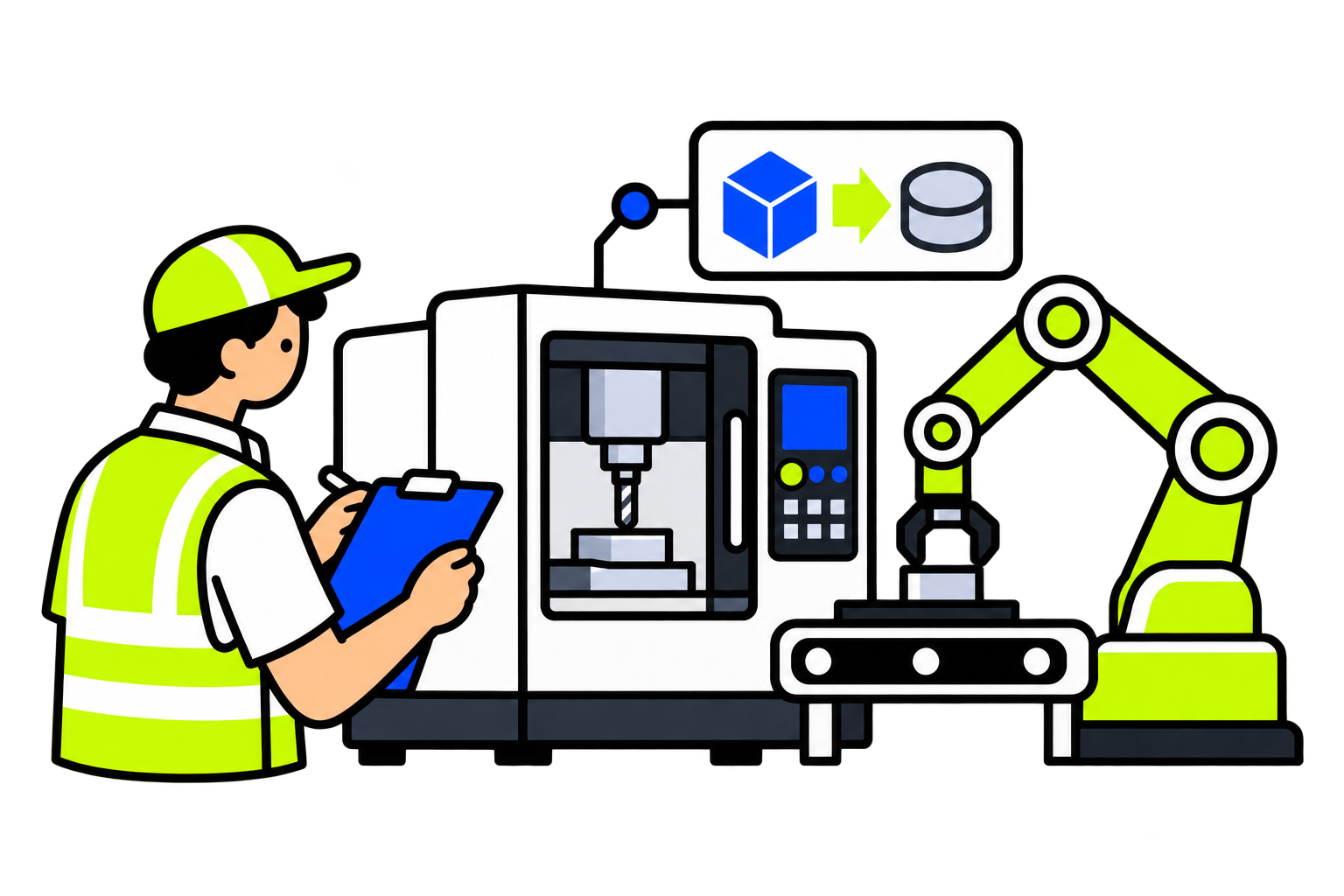
For a U.S. factory balancing product mix, customer deadlines and existing machinery, higher machine speed may leave the coordination problem untouched. We trace how sales commitments become purchasing decisions, work orders and shift instructions, then compare that picture with the floor.
A rush order changes the job sequence. Tooling is available, but inspection is still working from the previous revision. Before adding a robot, establish how revisions reach quality, scheduling and the operator, including the decision to stop or proceed.
Connect the relevant order, inventory and work-order events without assuming a full systems replacement.
Make revision status, changeovers and quality holds visible before optimizing an isolated cycle.
Compare coordination changes, software and physical automation against baseline costs and recovery needs.
Trace orders, purchasing, schedules and the decisions behind them. Talk with operators and observe the work early.
Bring the relevant records together with their owners, access limits and missing information visible.
Map dependencies, exceptions and uncertainty into a useful operating view. Validate it with the people doing the work.
Compare interventions against the constraint, business value, safety and recovery needs.
Build scoped software connections or test a bounded physical pilot when the operating case supports it.
Agree on ownership, monitoring, maintenance and escalation. Revise as products, suppliers and conditions change.
Goals to assess against your own baseline. We compare coordination time, rework, interruptions and ongoing support costs before recommending an investment.
Systems, decision owners, handovers and unresolved questions.
Candidate interventions, baseline measures and dependencies to test.
Interfaces, acceptance criteria, human checkpoints and support responsibilities.
Share your location, current systems and the recurring problem consuming your team’s attention. You do not need to have a technical solution in mind.
Often the first question is what can be connected safely and reliably. Share your ERP, machine models, interfaces and access constraints. We assess feasible connections and manual checkpoints before proposing replacements or robotics.
No. We establish a baseline and assess coordination time, interruptions, quality losses and ongoing support costs. Expected benefits need testing before an investment decision.
Your site, region, product or crop, scale, current systems, recurring delay and what you want to change.